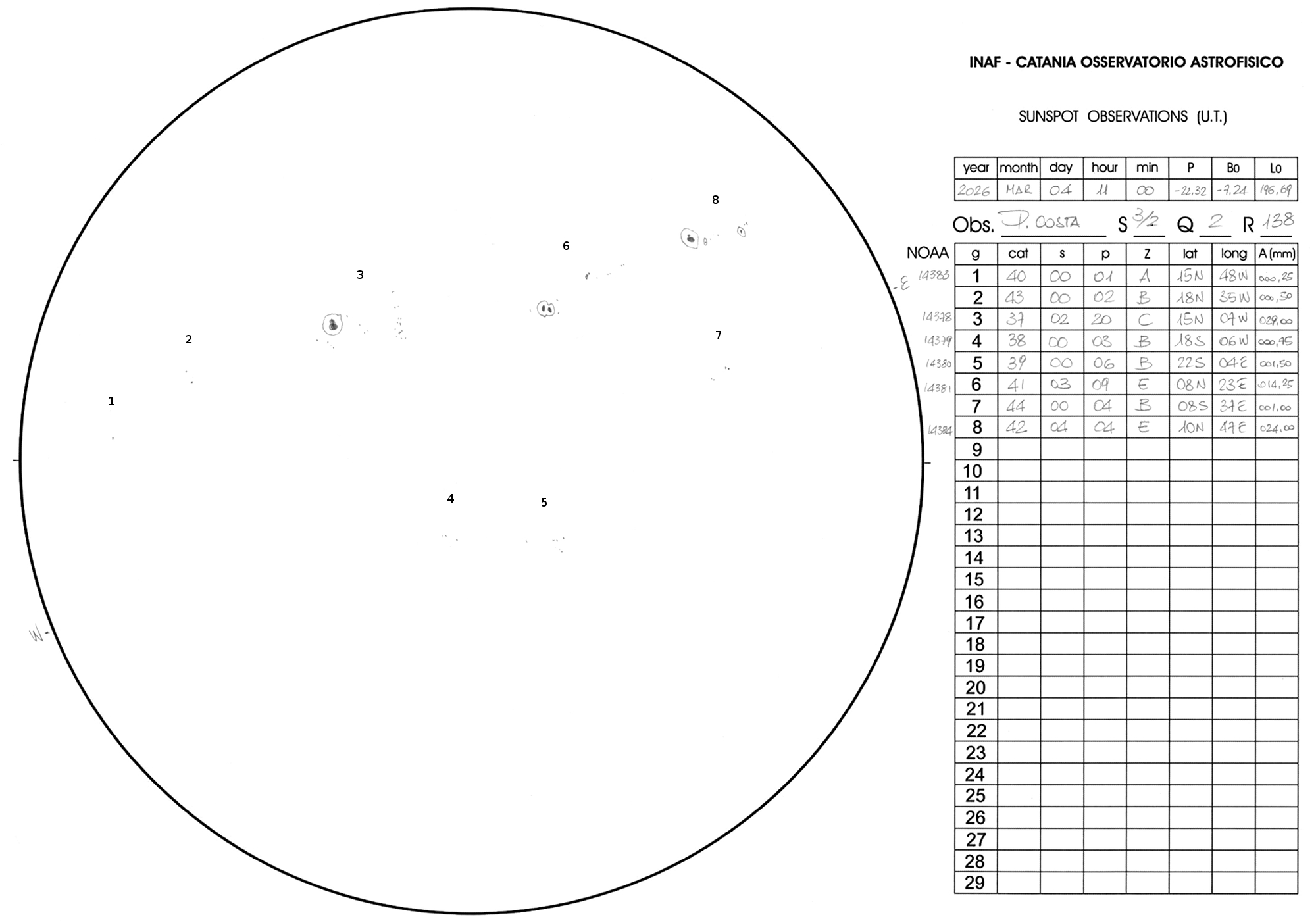
When the weather conditions permit, daily drawings of sunspot groups and pores are made by a Cooke refractor (150mm/2230 mm) on a 24.5 cm diameter projected image of the Sun.
These drawings are used to determine some characteristics of the SunSPotS groups visible on the photosphere and to report them in form of a numerical code (ursigram), named USSPS. The description of this code is reported in the help dialog window.
|
|
| download |

INAF/OACT Latest USSPS
All daily drawings of the sunspot groups and USSPS produced by INAF-Catania Astrophysical Observatory are available in the archive. Daily drawings of sunspot groups and pores are made by a Cooke refractor on a 24.5 cm diameter projected image of the Sun. These drawings are used to determine some characteristics of the SunSPotS group visible on the photosphere and to report them in form of a numerical code (ursigram), named USSPS. The USSPS describe the main characteristics of the SunSPotS groups observed in the photosphere.
Using the daily observation of the photosphere performed by the Equatorial Spar of INAF - Catania Astrophysical Observatory, we provide an indication of the probabilities that each sunspot group visible on the solar disc may host solar flares of C-, M- and X- class.
The sunspot groups capability of hosting flares is based on the Poisson statistics of five parameters: number of sunspots and pores, projected area of sunspot group in tens of millionths of the solar hemisphere, group type according to Zurich classification, type of penumbra of the main sunspot, and relative importance between leading sunspot and density of the sunspot population (Falco, M., Costa, P., Romano, P., "Solar flare forecasting using morphological properties of sunspot groups", 2019, Journal of Space Weather and Space Climate, Volume 9, id.A22, 9pp. DOI:10.1051/swsc/2019019).
All the information about the sunspot groups are reported in the ursigram with the following format:
USSPS 31405 JJHHH aaabc ddeee QXXYY fghii,
Daily drawings of sunspots groups and pores are maken between 8:00 and 14:00 local time (CET/CEST). When the weather is cloudy or ash falls due to the Etna eruptions the drawings are not provided.
The accuracy of the drawings depends on the experience of the operator and on their ability to distinguish the structures of the photosphere that are projected on the sheet.
In the USSPS archive webpage, clicking on the "Search" button provides the number of found records. Each record is identified by the date of observation. For each record three links appear:
A grey bar reporting different week of the year will help to distinguish different time intervals.
On the left side of the Latest USSPS webpage it is shown the ursigram and on the right side it is shown the corresponding drawing in JPEG 2000 format. Click on the image for a larger display.
The latest USSPS from Catania in a .txt format can be also downloaded clicking on "download".
API access to INAF/OACT Sunspot group characteristics
This product can also be used via a Web API (application programming interface) for programmatically accessing the files by requesting specific URL-encoded parameters. The list of mandatory and optional variables for this specific product are included in tables 1 and 2 below:
| Variable | Values required for this product |
|---|---|
| pc | S123a | 123ad |
| component | latest | archive |
| Variable | Values |
|---|---|
| query_date | yyyy-MM-ddT |
| img_ext | txt | jpeg |
Access to the latest data
The latest USSPS file is available at:
https://ssa.oact.inaf.it/prod/API/index.php?component=latest&pc=S123a
The webpage link returns the URL to the latest INAF/OACT Sunspot group characteristics file (USSPS.txt).
Example:
https://ssa.oact.inaf.it/prod/API/index.php?component=latest&pc=S123a
returns
https://ssa.oact.inaf.it/prod/data/latest_data/Latest_USSPS.txt
The latest draw file is available at:
https://ssa.oact.inaf.it/prod/API/index.php?component=latest&pc=S123ad
The webpage link returns the URL to the latest INAF/OACT Sunspot drawing file.
Example:
https://ssa.oact.inaf.it/prod/API/index.php?component=latest&pc=S123ad
returns
https://ssa.oact.inaf.it/prod/data/latest_data/Latest_Draw.jpg
Access to archive data
To access archive data, the "component" parameter in the address bar needs to be set "archive": component=archive.
In order to select a specific day, the following parameter needs to be setted: "query_date" using the format yyyy-MM-ddT.
For example: https://ssa.oact.inaf.it/prod/API/index.php?component=archive&pc=S123a&query_date=2020-06-15&img_ext=txt
This returns a JSON containing a list of all archived INAF/OACT Sunspot group characteristics file (USSPS.txt) during the selected date (here the 2020-06-15).In order to select from different image products, the data type parameter can be added:
"img_ext = txt" returns the USSPS.txt file;
"img_ext = jpeg" returns the Sunspot drawing file.
This returns a JSON containing the archived INAF/OACT Sunspot group characteristics file or Sunspot drawing file during the selected day.
The data structure of the returned JSON is as follows:
JSON format for img_ext=txt and img_ext=jpeg
{
"[file url]": {"size":[KB],"modify":[datetime]},
REPEAT
"[file url]": {"size":[KB],"modify":[datetime]},
REPEAT
}
For example, the link above returns:
{"./data/ussps/2020/06/200615.txt": {"size":"---","modify":"---"}}
